The Scale is Staggering (And That Matters)
Let me start with something that genuinely astonished me when I first saw the numbers: Khan Academy’s Khanmigo has logged over 50 million student interactions since rolling out more broadly. That is not a small pilot program. That is not a handful of enthusiastic early adopters. That is a fundamental shift in how students are accessing personalized math help, and by the end of 2025, over 500 U.S. school districts had integrated Khanmigo into their classrooms. To put this in perspective, we are talking about one of the most widely deployed AI tutoring systems in K-12 history, sitting right alongside the traditional tools teachers like me have relied on for years.
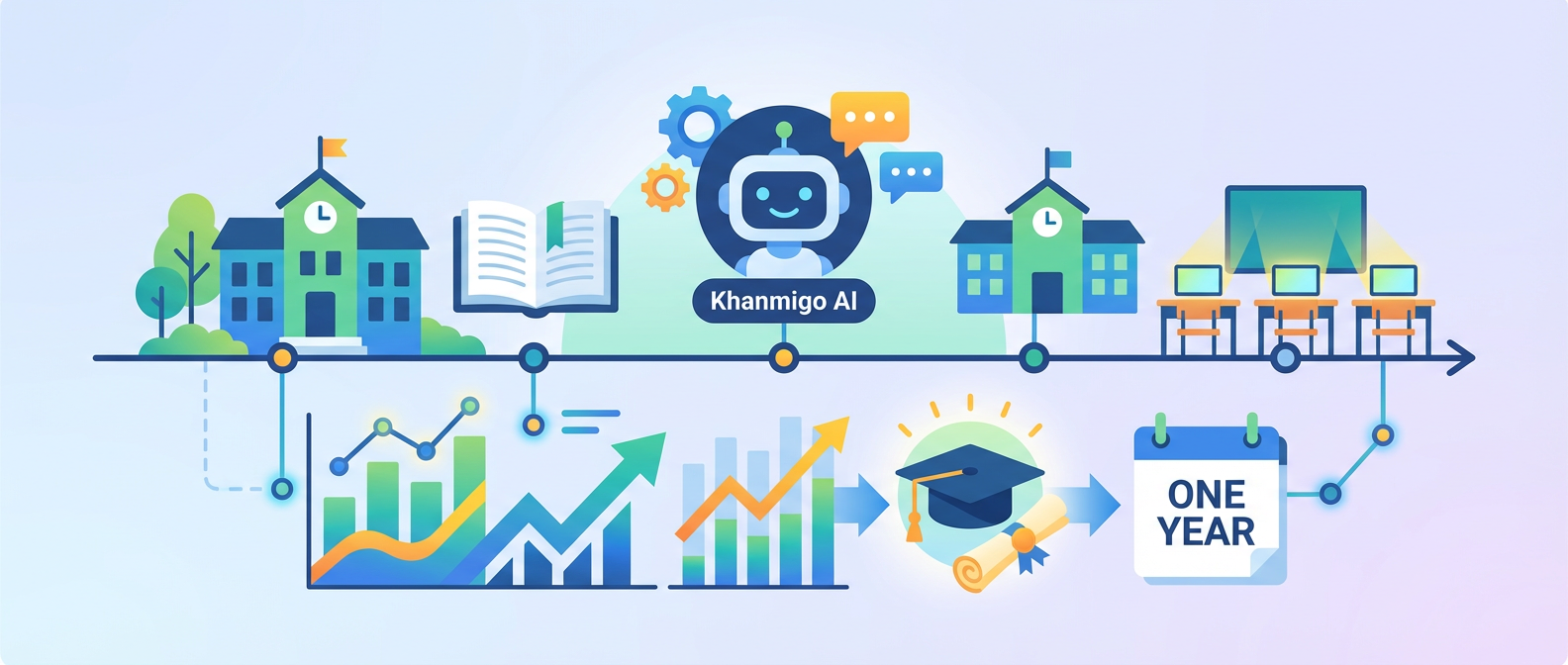
What strikes me most is not just the number of interactions, but what those interactions represent. Each one is a moment where a student chose to ask a question instead of staying stuck. Each one is a data point showing us which concepts students struggle with, when they ask for help, and how they respond to different explanations. When you have 50 million of those moments, you start seeing patterns that actually change how you think about teaching.

The Algebra Completion Breakthrough (and What It Really Means)
Here is where I get genuinely excited, because completion rates are not just vanity metrics. When I talk to colleagues who teach middle school algebra, the refrain is always the same: students fall behind, they lose confidence, and then they disconnect. Khan Academy’s data showing measurable gains in algebra completion rates among middle schoolers tells me something specific is happening. Students are not just attempting more problems. They are actually finishing units that, historically, would have been abandoned.
Why does this matter? Completion in algebra is not just about checking boxes. It is about building the conceptual foundation that everything else in math rests on. A student who finishes an algebra unit with actual understanding is not just passing a test. They are setting themselves up for geometry, pre-calculus, any STEM path they choose. The frustration I see most often is not from students who cannot do algebra. It is from students who believe they cannot. Khanmigo appears to be addressing that belief gap, one completed unit at a time.
The 12% Improvement and Who It Helps Most
I want to highlight something that might seem buried in the research but is actually significant. A 2025 RAND Corporation study found that when students used AI tutoring tools consistently for over 30 minutes per week, standardized math scores improved by 12% on average. That 12% is not a rounding error. In many cases, it represents the difference between proficiency and mastery, between struggling and succeeding. But here is the part that really matters: this effect was most pronounced in Title I schools, the districts serving our lowest-income students.
This is the moment where the research moves from interesting to urgent. Access to private tutoring has long been a luxury. Families with resources hire tutors. Families without resources hope their teacher has time to provide individual help after 150 other students. Khanmigo, deployed at scale across under-resourced districts, is beginning to level that playing field. RAND Corporation AI in Education Research confirms something we have known theoretically for years: when struggling students get consistent, personalized support, they accelerate. The question was always whether technology could provide that support affordably. The data suggests it can.
Why Socratic Questioning Outperforms Just Giving Answers
This is where learning science and classroom reality align in a way that genuinely delights me. Stanford’s Graduate School of Education released findings showing that when AI tutors asked questions rather than providing direct answers, student self-efficacy scores improved significantly. Students felt more confident in their own ability to solve problems independently. This is not just semantics. This is the difference between learning and depending on a tutor.
When I teach, I deliberately resist the impulse to immediately solve a problem for a confused student. Instead, I ask: what do you know? What are you trying to find? What operation might connect those two things? It feels slower in the moment. It feels like it would be faster to just show them. But here is what actually happens: students who work through that guided questioning process own the answer. They can do it again tomorrow without me. They believe they are capable. Khanmigo has apparently coded this principle into its interactions. Khan Academy Khanmigo Official Overview shows exactly this design philosophy at work. The tool does not just answer questions. It tutors.
The research tells us this is working. When students experience that Socratic approach, they develop what researchers call agency. They begin to see themselves as problem-solvers rather than problem-receivers. Over time, that shift in identity is often more valuable than any single skill they learn.
The Future is Already Here (But It Needs Support)
The Gates Foundation’s commitment of $20 million in 2025 specifically to expand AI-assisted tutoring access in under-resourced schools signals something important: foundations and policymakers recognize that tools like Khanmigo are no longer experimental. They are infrastructure. We are at the point where the question is not whether these tools work. The question is how to deploy them equitably and how to train teachers to use them effectively as part of instruction rather than as a replacement for it.
Let me be clear about something. I am a teacher who believes deeply in the irreplaceable value of human instruction. I also believe deeply in evidence. The data from one year of Khanmigo in classrooms shows that when deployed thoughtfully, AI tutoring tools can provide the kind of consistent, personalized support that students need to succeed. 50 million interactions. 12% score improvements in the schools that need them most. Improved self-efficacy through Socratic questioning. These are not small claims. These are measurable shifts in how students learn.
What are you seeing in your own learning journey or in classrooms near you? Have you tried Khanmigo, or are you thinking about how AI tutoring might fit into your routine? I would genuinely love to hear what questions you have or what outcomes matter most to you in thinking about these tools.