The Seismic Shift We’re Actually Witnessing
Let me be direct with you: we’re at a pivot point in how students engage with knowledge, and it matters more than most people realize. Google’s expansion of NotebookLM’s Audio Overviews feature to over fifty languages in late 2025 just reached an estimated one billion additional users globally. This isn’t a marginal technology update. This is infrastructure changing overnight. When a tool becomes this accessible, this intuitive, and this embedded into how students work, the whole system has to recalibrate.
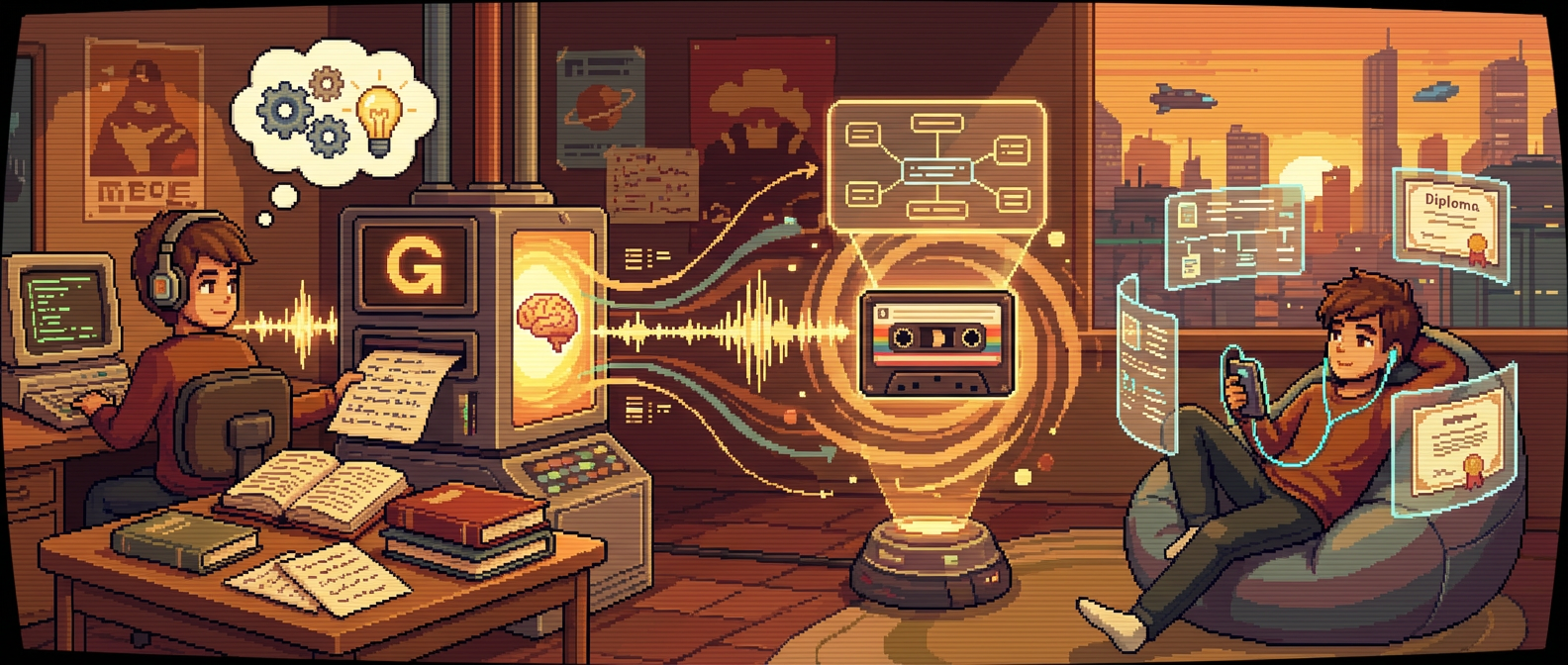
I’ve watched educational technology move through cycles before. Some innovations fade because they don’t solve real problems. Others stick because they tap into something fundamental about how humans learn. The question I want us to sit with isn’t whether Audio Overviews are good or bad. The real question is: what structural changes do we need to make in how we teach and assess so that this tool actually deepens learning instead of replacing the messy, productive struggle that builds understanding?

Understanding What’s Actually Happening with Cognitive Load
Here’s what makes this complicated, and why I think we need to talk about it clearly. Cognitive load theory, developed by psychologist John Sweller back in 1988, describes how our brains have limited capacity for processing information. When we’re reading a dense primary source, we’re managing extraneous load (fighting confusing formatting, unfamiliar vocabulary), intrinsic load (the actual complexity of the concepts), and germane load (the mental effort we’re using to build understanding). It’s exhausting partly because it should be. That struggle is where learning happens.
Researchers at Stanford’s Learning Research Lab are now actively revisiting this framework because of what AI-generated audio summaries are doing. When NotebookLM creates that smooth, conversational audio overview, it dramatically reduces extraneous load. That sounds good. It is, partially. But here’s the research that keeps me up at night: a 2025 study in the Journal of Educational Psychology found that students who consumed audio summaries of complex texts scored twelve percent lower on deep-comprehension assessments compared to those who read the primary sources directly. Not a little lower. Meaningfully lower. The students felt like they understood because the information was accessible, but when we measured what they actually retained and could apply, the gap was real.
This tells me something important: we cannot treat Audio Overviews as a replacement for engaging with source material. We have to treat them as one piece of a deliberately designed sequence. That’s system design. That’s the work we should be doing right now instead of waiting to see what happens.
The Adoption Reality and the Policy Gap We’re Creating
Here’s what the numbers tell us. NotebookLM hit ten million active users within eighteen months of its public launch, according to Google’s 2025 I/O announcements. That’s explosive adoption. For comparison, it took educational institutions decades to standardize how we use textbooks. We don’t have decades here. Students are already using these tools in their study processes, whether or not we’ve given them permission or guidance.
Policy has been scrambling to catch up. A January 2026 Educause survey found that thirty-four percent of college instructors had already updated their academic integrity policies specifically to address AI audio summarization tools. More than one in three. But here’s what concerns me: are these policies thoughtfully designed to encourage productive use, or are they mostly prohibition statements written in panic? I’m seeing both, and the situation is inconsistent enough that students genuinely don’t know what’s expected of them from class to class.
We need to move from “is this allowed?” to “when and how does this serve your learning?” Those are different questions with very different answers. The Educause 2026 Higher Education Technology Report documents this exact tension, and I think it’s the most important tension we need to resolve this year.
Designing a Coherent Learning Sequence That Uses These Tools Intentionally
So what does intentional design actually look like? I’ll give you the structure I’m developing for my own classroom, because being specific matters more than being theoretical. First, students read or listen to the primary source material. That’s the germane load work where they’re building initial understanding. Then, and this is the part people skip, they use NotebookLM Audio Overviews not as a replacement but as a reflection tool. They listen to what the system pulled out, they notice what it emphasized, and they ask themselves: did the tool understand this the way I understood it? What did I miss? What did it emphasize that I skimmed?
That reflection creates a different kind of cognitive work. They’re not passively absorbing a summary. They’re actively comparing their comprehension to an algorithmic interpretation. That’s generative. Then they write. Not a summary, but a perspective piece or a problem application. Google NotebookLM’s official features overview shows that the tool can create audio from notes students take, which means they can use this for synthesis. They take notes on the source material, feed those notes into NotebookLM, hear their own thinking back in a new format, and that often prompts deeper integration.
The sequence works when we use this as a layer, not a substitute. That distinction changes everything about how we should be teaching right now.
What This Means for How You Study or Teach in 2026
If you’re a student reading this, I want to give you permission to use these tools, but with some intention behind it. Use Audio Overviews after you’ve engaged with material, not instead of engaging with it. Use them to notice what you might have misunderstood. Use them as a study companion, not a study replacement. And be honest with yourself about whether the listening is deepening your understanding or creating an illusion of it. That feeling of “oh, I get it now” after hearing a summary is sometimes genuine comprehension and sometimes the mere exposure effect playing tricks on your brain.
If you’re an educator, I’m asking you to do the harder work right now. Don’t just prohibit these tools. Design your curriculum so intentionally that they become optional supplements to a learning sequence that’s already compelling. When students see that reading the source material and thinking critically about it produces deeper insight than taking a shortcut, they make different choices. That takes more planning than writing a policy against AI use, but it builds actual capacity instead of just creating compliance.
I’d genuinely love to hear how you’re thinking about this in your own context. What patterns are you noticing with students and these tools? What’s working, and what’s creating that nagging feeling that something important is getting skipped? Share your thinking in the comments or reach out directly. We’re designing this in real time, and that only works if we’re doing it together.