The Honest Reality: AI Tutors Are Here, and They’re Actually Useful
Twelve months ago, I watched my district roll out Khanmigo to our school with the kind of cautious optimism that comes from years of watching ed-tech initiatives arrive with tremendous fanfare and then quietly disappear into a closet somewhere. But here’s what I need to tell you upfront: this one is different. I’m not saying it’s revolutionary or that it’s solving every problem in my classroom. I’m saying that after a full year of using it alongside thirty teenagers who are remarkably honest about when something is and isn’t working, I’ve observed something genuinely valuable happening.

When Khan Academy expanded Khanmigo to reach over a million students across public schools by late 2025, I was teaching in one of those pilot districts. The platform offers conversational AI tutoring, which means students don’t just watch videos or answer multiple choice questions. They actually talk through concepts with an AI that responds to their specific confusion. That distinction matters more than you might think, and I’ll explain why throughout this article.
The engagement metrics coming out of our district paint part of the picture. We saw a 23% improvement in student engagement measures among classrooms using the tool regularly. But engagement numbers on a spreadsheet don’t capture what I actually see: Marcus staying after school to work through systems of equations because the AI caught that he was confusing the elimination method with substitution, then broke it down in a way that finally clicked. That’s not a data point. That’s a student finding his way back into mathematics.
Where the Learning Science Actually Shows Up
Here’s the part where I get to pull on my learning science background. What makes Khanmigo different from earlier AI tutoring attempts is that it’s built on principles researchers have validated for decades. Conversational tutoring isn’t new. It’s literally what I do when a student comes to my desk confused. What’s new is that students who might never ask for help now have access to that experience any time they’re working on homework at night or during a study period.
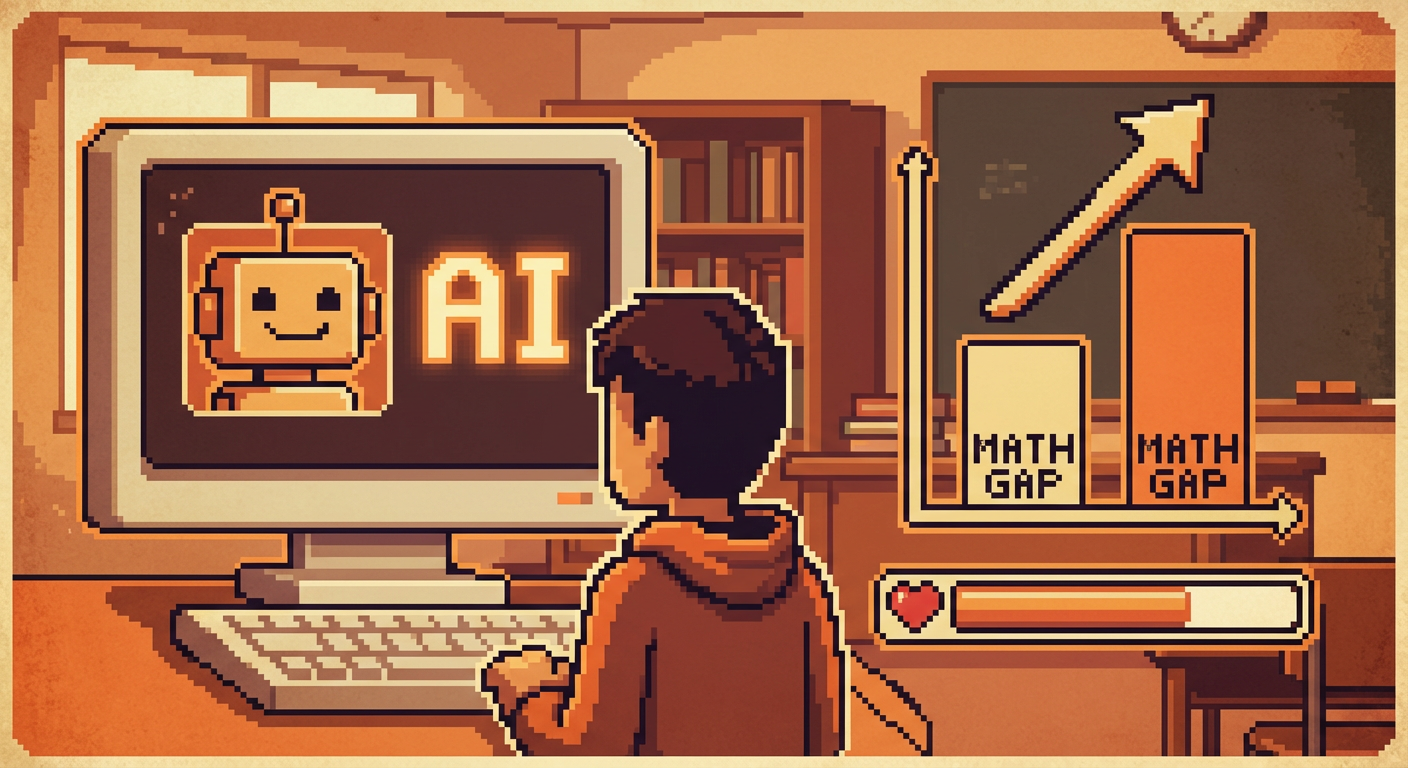
Research from Stanford CREDO Education Research released in 2025 found something particularly striking: AI-assisted tutoring narrowed the math achievement gap by 0.15 standard deviations among low-income students over a single semester. That’s not enormous, but in learning science terms, that’s meaningful. It’s the difference between a student feeling lost all year and a student understanding where they fit into the material. Achievement gaps don’t close on accident, and they don’t close with tools that treat all learners the same way. This tool appears to do something genuinely different for students who need the most support.
What I’ve noticed in my own classroom is that the conversational element matters differently for different students. For some, it addresses a confidence issue. They feel less vulnerable admitting confusion to a screen than to a peer or even to me sometimes. For others, it’s about pacing. The AI doesn’t rush. It doesn’t have twenty other questions from other students waiting. It stays with you until you understand. That’s not a luxury most tutors can offer, and it’s certainly not something I can provide to thirty students simultaneously when I’m also managing homework collection, attendance, and the thousand other things that happen in a classroom.
The Real Time Shift in What Teachers Actually Do
This is where I want to address something that doesn’t get enough attention. According to research from McKinsey & Company’s 2025 education report, teachers using AI tutoring platforms like Khanmigo spend an average of 4.2 fewer hours per week grading routine assessments and administering basic skill checks. Let me translate what that means in actual teacher language: I’m not spending Thursday evening going through forty practice worksheets marking right and wrong answers. I’m spending Thursday evening planning a small group session for students who need additional scaffolding, or I’m creating a project that asks students to apply their learning in a way that matters.
That shift matters because it gets at one of the most persistent problems in American classrooms: teachers are drowning in assessment administration when they should be focused on instruction. I had a colleague who spent so much time on grading that she barely had mental energy to think about whether students were actually learning or just memorizing the problem type. Now that machine learning is handling some of that load, I’m actually present in my classroom in a different way.
But here’s what I’m also noticing: I’m not replacing myself, and that’s important. The AI doesn’t know that Jamie benefits from drawing things out, that Alexis thinks out loud, that Marcus has dyscalculia and needs me to validate that he’s working with that challenge. I’m using the time that Khanmigo buys me to actually know my students better and to design instruction that meets them where they are. That’s the ideal scenario. Whether every teacher uses that time that way is, of course, another question entirely.
The Problem That Worries Me Most: We’re Not Actually Training Teachers
Here’s where I need to get direct about something that troubles me. When Common Sense Media surveyed teachers in 2025 about AI tutoring tools in their districts, 61% of respondents said they felt undertrained on how to use these platforms effectively. I’m sitting in that percentage, honestly, and I have some background in learning science and educational technology. Most teachers in my building don’t have that background. They’re getting Khanmigo installed on their school computers with maybe a thirty-minute professional development session about how to access it.
The Gates Foundation committed $200 million toward AI literacy tools for K-12 classrooms in 2025, specifically prioritizing conversational AI tutors. That’s genuine investment in this direction. But money toward tools means nothing without serious investment in teacher preparation. I’m not talking about a one-time training. I’m talking about ongoing professional learning that helps teachers understand what conversational AI tutors can actually do, how to integrate them into instruction meaningfully rather than as a placeholder, how to interpret the data these tools generate, and how to troubleshoot when it’s not working.
The result right now is uneven adoption. Some teachers in my building have genuinely integrated Khanmigo into their practice. Others assigned it once, got a mixed response, and moved on. Some view it as a motivational tool. Some are still uncertain about letting AI interact with their students at all. That’s not a problem with the tool. That’s a problem with implementation, and it’s a problem we’ve seen over and over with every ed-tech initiative that arrives without sufficient educator preparation.
What I’m Actually Recommending to Teachers Right Now
If you’re a teacher sitting on the fence about whether to use Khan Academy Khanmigo for Teachers or a similar platform, here’s my honest advice based on a full year of experience. Start small. Pick one concept or unit where you know your students consistently struggle and where you could genuinely use support identifying exactly where individual students are getting stuck. Use the tool for a few weeks, pay attention to the conversation transcripts that students generate, and see what you learn. Notice whether it’s helping certain students more than others and whether that aligns with what you know about their needs.
Second, engage with the data responsibly. These platforms generate information about where students are in their learning, but that data needs human interpretation. It tells you where Marcus is getting confused, but you’re the one who needs to decide whether the issue is computational fluency, conceptual understanding, or something else entirely like test anxiety or past negative experiences in math.
Third, be honest about the time shift. If you use this tool, commit to actually spending that reclaimed time on instruction and student relationships rather than just picking up additional grading or assessment tasks. That’s where the real benefit emerges.
One year in, I’m convinced that AI tutors like Khanmigo are genuinely useful in classrooms, but they’re useful as tools that support better teaching, not as replacements for thoughtful instruction. The learning science is sound. The engagement is real. The equity implications are worth paying attention to. But whether these tools actually transform education depends almost entirely on whether we invest seriously in helping teachers use them well. That’s the conversation I think we should be having right now.